Saturday, September 14, 2019

Scrum Events - Sprint Review

Sprint Review

A Sprint Review is held at the end of the Sprint to inspect the Increment and adapt the Product Backlog if needed. During the Sprint Review, the Scrum Team and stakeholders collaborate about what was done in the Sprint. Based on that and any changes to the Product Backlog during the Sprint, attendees collaborate on the next things that could be done to optimize value.

This is an informal meeting, not a status meeting, and the presentation of the Increment is intended to elicit feedback and foster collaboration.

This is a four-hour time-boxed meeting for one-month Sprints. For shorter Sprints, the event is usually shorter. The Scrum Master ensures that the event takes place and that attendants understand its purpose. The Scrum Master teaches all to keep it within the time-box.

Sprint Review
Sprint Review


The Sprint Review includes the following elements:

- Attendees include the Scrum Team and key stakeholders invited by the Product Owner;

- The Product Owner explains what Product Backlog items have been “Done” and what has not been “Done”;

- The Development Team discusses what went well during the Sprint, what problems it ran into, and how those problems were solved;

- The Development Team demonstrates the work that it has “Done” and answers questions about the Increment;

- The Product Owner discusses the Product Backlog as it stands. He or she projects likely completion dates based on progress to date (if needed);

- The entire group collaborates on what to do next so that the Sprint Review provides valuable input to subsequent Sprint Planning;

- Review of how the marketplace or potential use of the product might have changed what is the most valuable thing to do next; and,

- Review of the timeline, budget, potential capabilities, and marketplace for the next anticipated release of the product.

The result of the Sprint Review is a revised Product Backlog that defines the probable Product Backlog items for the next Sprint. The Product Backlog may also be adjusted overall to meet new opportunities.

Scrum Events - Daily Scrum

Daily Scrum

The Daily Scrum is a 15-minute time-boxed event for the Development Team to synchronize activities and create a plan for the next 24 hours. This is done by inspecting the work since the last Daily Scrum and forecasting the work that could be done before the next one.

Daily Scrum
Daily Scrum


The Daily Scrum is held at the same time and place each day to reduce complexity. During the meeting, the Development Team members explain:

 - What did I do yesterday that helped the Development Team meet the Sprint Goal?

 - What will I do today to help the Development Team meet the Sprint Goal?

 - Do I see any impediment that prevents me or the Development Team from meeting the Sprint Goal?


The Development Team uses the Daily Scrum to inspect progress toward the Sprint Goal and to inspect how progress is trending toward completing the work in the Sprint Backlog.

The Daily Scrum optimizes the probability that the Development Team will meet the Sprint Goal. Every day, the Development Team should understand how it intends to work together as a selforganizing team to accomplish the Sprint Goal and create the anticipated Increment by the end of the Sprint.

The Development Team or team members often meet immediately after the Daily Scrum for detailed discussions, or to adapt, or replan, the rest of the Sprint’s work.

The Scrum Master ensures that the Development Team has the meeting, but the Development Team is responsible for conducting the Daily Scrum.

The Scrum Master teaches the Development Team to keep the Daily Scrum within the 15-minute time-box. The Scrum Master enforces the rule that only Development Team members participate in the Daily Scrum.

Daily Scrums improve communications, eliminate other meetings, identify impediments to development for removal, highlight and promote quick decision-making, and improve the Development Team’s level of knowledge. This is a key to inspect and adapt to the meeting.

Scrum Event - Sprint Planning

Sprint Planning

The work to be performed in the Sprint is planned at the Sprint Planning. This plan is created by the collaborative work of the entire Scrum Team.

Sprint Planning is time-boxed to a maximum of eight hours for a one-month Sprint. For shorter Sprints, the event is usually shorter.

The Scrum Master ensures that the event takes place and that attendants understand its purpose. The Scrum Master teaches the Scrum Team to keep it within the time-box.

Sprint Planning answers the following:
  1. What can be delivered in the Increment resulting from the upcoming Sprint?
  2. How will the work need to deliver the Increment be achieved?
Sprint Planning
Sprint Planning


Topic One: What can be done this Sprint?

The Development Team works to forecast the functionality that will be developed during the Sprint.

The Product Owner discusses the objective that the Sprint should achieve and the Product Backlog items that, if completed in the Sprint, would achieve the Sprint Goal. The entire Scrum Team collaborates on understanding the work of the Sprint.

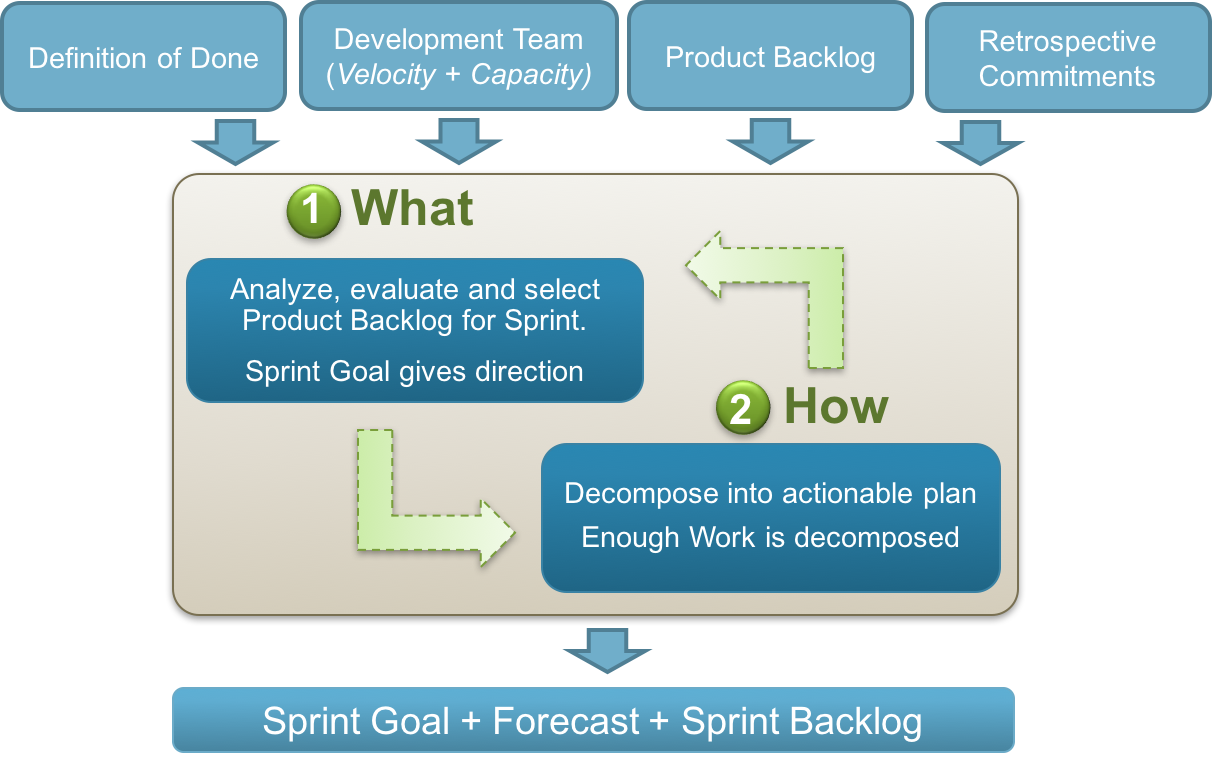
The input to this meeting is the Product Backlog, the latest product Increment, projected capacity of the Development Team during the Sprint, and past performance of the Development Team.

The number of items selected from the Product Backlog for the Sprint is solely up to the Development Team. Only the Development Team can assess what it can accomplish over the upcoming Sprint.

After the Development Team forecasts the Product Backlog items it will deliver in the Sprint, the Scrum Team crafts a Sprint Goal. The Sprint Goal is an objective that will be met within the Sprint through the implementation of the Product Backlog, and it provides guidance to the Development Team on why it is building the Increment.

What & How in Sprint Planning


Topic Two: How will the chosen work get done?

Having set the Sprint Goal and selected the Product Backlog items for the Sprint, the Development Team decides how it will build this functionality into a “Done” product Increment during the Sprint.

The Product Backlog items selected for this Sprint plus the plan for delivering them is called the Sprint Backlog.

The Development Team usually starts by designing the system and the work needed to convert the Product Backlog into a working product Increment. Work may be of varying size or estimated effort. However, enough work is planned during Sprint Planning for the Development Team to forecast what it believes it can do in the upcoming Sprint.

Work planned for the first days of the Sprint by the Development Team is decomposed by the end of this meeting, often to units of one day or less.

The Development Team self-organizes to undertake the work in the Sprint Backlog, both during Sprint Planning and as needed throughout the Sprint.

The Product Owner can help to clarify the selected Product Backlog items and make trade-offs. If the Development Team determines it has too much or too little work, it may renegotiate the selected Product Backlog items with the Product Owner.

The Development Team may also invite other people to attend in order to provide technical or domain advice.

By the end of the Sprint Planning, the Development Team should be able to explain to the Product Owner and Scrum Master how it intends to work as a self-organizing team to accomplish the Sprint Goal and create the anticipated Increment.

Sprint Goal

The Sprint Goal is an objective set for the Sprint that can be met through the implementation of Product Backlog. It provides guidance to the Development Team on why it is building the Increment. It is created during the Sprint Planning meeting. The Sprint Goal gives the Development Team some flexibility regarding the functionality implemented within the Sprint.

The selected Product Backlog items deliver one coherent function, which can be the Sprint Goal. The Sprint Goal can be any other coherence that causes the Development Team to work together rather than on separate initiatives.

As the Development Team works, it keeps the Sprint Goal in mind. In order to satisfy the Sprint Goal, it implements the functionality and technology. If the work turns out to be different than the Development Team expected, they collaborate with the Product Owner to negotiate the scope of Sprint Backlog within the Sprint.